
Inside the Delaware AI Stack and the UCF One Coming June 25
Recap of the May 28 Use Case Lab with University of Delaware on PATHS Engine and the federated learning pilot, plus what's coming June 25 with UCF's Tyler Walsh on Knightbot — and one more place to go

Most higher ed leaders are still asking where to start with AI. A handful of institutions are already three years in. On May 28, two of them sat down with me in the Higher Ed AI Playbook Use Case Lab: Nova Harris and Lauren Kelley from the University of Delaware’s Academic Technology Services, who have been building PATHS Engine since 2022 — the week ChatGPT broke into the wider conversation. What they have built together is the rare AI project in higher ed that is technically real, pedagogically serious, and institutionally trusted.
What follows is a partial recap of that conversation. The full recap, with quotes, the federated learning pilot mechanics, the three governance lessons, and the operational through-line for institutions wanting to build something similar, continues below for paid subscribers.
Mark Your Calendar: Tyler Walsh, UCF, Thursday June 25
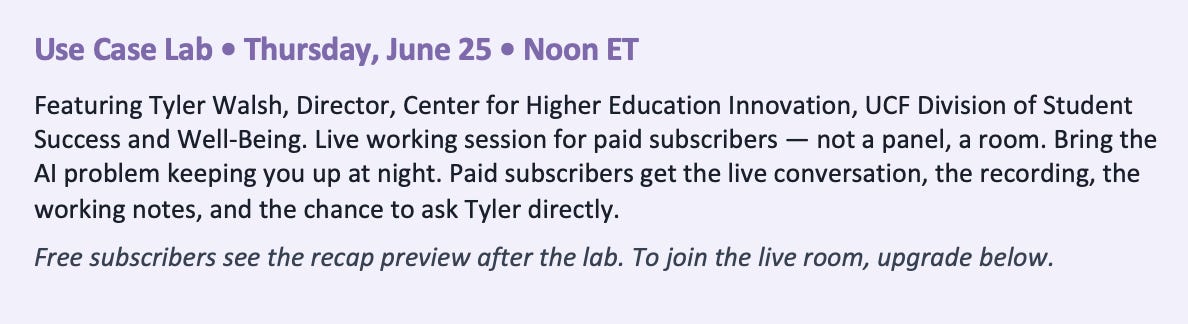
The next Use Case Lab is Thursday, June 25 at noon ET, featuring Tyler Walsh, Director of the Center for Higher Education Innovation in UCF’s Division of Student Success and Well-Being. Tyler leads the team behind Knightbot, the AI-powered student-support system serving UCF’s 70,000+ students — and the work he is doing is one of the cleanest examples I have seen of operational redesign and measurable outcomes happening at scale in the same institution.

UCF’s reported numbers are the kind of evidence the sector needs more of. Per UCF News, Knightbot has fielded more than 459,000 incoming messages from 277,000 unique users since launching in January 2023, resolving 85 percent of student queries without human intervention and freeing approximately 12,000 hours of staff time — equivalent to six full-time employees. Students engaged in a recent enrollment campaign were 50 percent more likely to enroll than those who did not respond. A drop-prevention campaign reached over 1,000 students and reduced the drop rate by 15 percent among those who engaged.
And This Week: AiM Higher 2026 at the University of Delaware
Before June 25, there is another room worth being in this week. The University of Delaware — the same team behind PATHS Engine — is hosting AiM Higher 2026 on June 9–11. It is not a watch-the-slides conference. It is a problem-based learning event built around a Five Scenario Framework: institutions come in with a real problem (AI policy, AI literacy across the curriculum, scaling support services, professional development, governance), get paired with Pathfinder Fellows who have lived through similar work, and leave with a proof of concept built in the AI Makerspace. Nova and Lauren are at the center of it. Sponsors include Zoom and EBSCO.
I attended last year; the actionability of what people walked away with was the difference between this and most AI-in-higher-ed events. Conference site: sites.udel.edu/aim-higher • Five Scenario Framework: sites.udel.edu/aim-higher/the-five-scenario-framework-2026
Now, the May 28 Lab: PATHS Engine and the Federated Learning Pilot
Back to Delaware. PATHS Engine takes unstructured academic content — PowerPoints, PDFs, Canvas courses, lecture-capture transcripts — and turns it into structured learning objects the faculty member approves before students see anything. The AI works from the professor’s own material, not a frontier model’s training set. Students get tools sourced from the course. Faculty keep authority over what their content becomes.
Nova described the original move plainly: “We decided that, what if we built a kind of walled garden where we can have the faculty member feel safe using AI and the students feel like they have permission to use AI — but both will be sourced from the faculty data.”
That sounds modest. It is not. It is the answer to a question most institutions have not yet figured out how to ask, much less solve: how do you give students access to AI tools that actually map to their course — without sending faculty intellectual property to a vendor, without scraping, without surrendering institutional data to a black box?
The first faculty partners were not random. Nova started with what every institution has: the early adopters who had already trusted the office’s work on lecture capture and classroom technology. “Every institution has their superstars or their super users,” Nova said. The faculty member she called first had years of lecture-capture recordings already in the system — a deep pool of source material to test on, and a faculty member who already trusted the team. That sequencing matters: the institutions that try to launch AI tools by pushing them out to all faculty at once fail. The institutions that start with the faculty who already trust the technology office build something durable.
PATHS Engine is the Operational Redesign pillar of the AI-Ready Institution Framework, made concrete: a core institutional process (teaching with AI) rebuilt with privacy, consent, and faculty authority designed in from the first decision, not bolted onto a commercial chatbot after the fact. It is also a Governance story, because of how UD built faculty trust along the way, and an Evidence story, because of how UD is starting to measure whether the tools actually help students study.
Paid subscribers continue below: the three engineered choices that built faculty trust, how UD measures whether the tools actually help students, the full mechanics of the federated learning pilot across Delaware, three governance lessons, and the operational through-line for institutions that want to build something similar — plus access to the June 25 Tyler Walsh lab live.